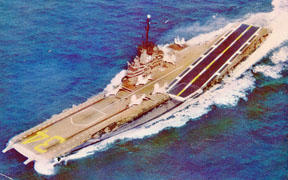
The Oriskany wasn’t the first ship I was on, but it was one of the most memorable ones. My career in the Navy started in San Diego Naval training center in February 1964. Like everyone else, I became a number for the duration of my basic training. Our vocabulary was, “Sir, Yes Sir”. We didn’t need to say much more. I weighed about 150 lbs. when I entered Boot camp & 130 when I graduated. All my fat became muscle. I had no idea that I was capable of doing 50 pushups. We were referred to as “Maggots”, “F__d up as Hogan’s Goat” & many other colorful names. Back then the drill instructors were allowed to treat us very differently than they are today. We were used to people like our school teachers, beating us with a wooden paddle when we misbehaved in class. In those days it was “Spare the rod & spoil the child”.
It wasn’t all bad. We got 3 meals a day, a bed to sleep on & a lot of classroom training. We were introduced to all the different fields we could go into, in the Navy & asked to pick 3 that we wanted to go into. I picked Radioman & 2 others. Then they told me “You’re going to be an Electrician”. So much for choosing. I also had the privilege to sing in “The Bluejacket’s Choir”. We sang at church services every week & on one occasion were invited to sing for then President Eisenhower, at the El Cortez Hotel in downtown San Diego. That was something I will never forget.
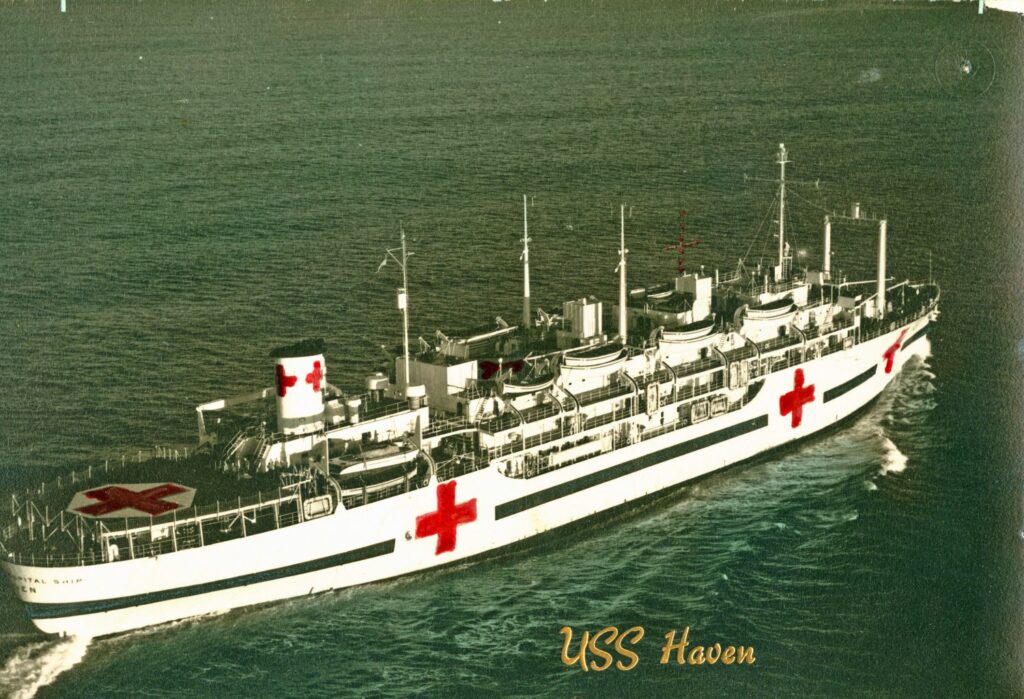
After I graduated from Boot Camp I got orders to the hospital ship, USS Haven AH-12, which was being used as the Navy Hospital in Long Beach, California, while the real hospital was being remodeled. As a future Electrician I had to change broken light bulbs & tour the ship as part of security round, including the ship’s morgue. I luckily didn’t see any bodies there. One day they had us go around & count all the lights that weren’t working, because they were thinking of taking the ship to Vietnam. That never happened & eventually they just decommissioned it instead, after the renovations of the regular hospital were complete. In September 1964 I got orders to attend Basic Electician’s School in San Diego. I did real well there, finishing 1st in my class. In February the next year I was ordered to the USS Oriskany which was in San Diego at the time.
This is when the fun began.
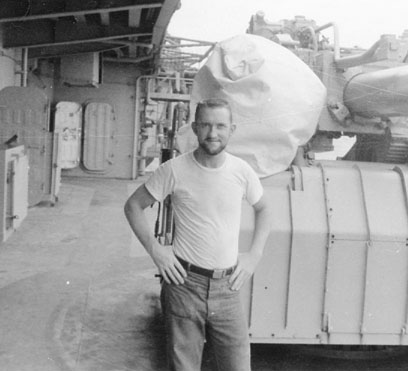
As a new electrician on the ship I had to put up with a few things, such as finding a place to sleep at night. The E Division berthing compartment had 140 bunks. I was Number 141. Because of that, they gave me a cot, a blanket & a pillow. I had to find a place on the ship to set it up at night. I tried the Lighting Shop, which is where I worked out of, but it was too hot (there was no air conditioning on the ship except for critical electronic spaces). The other 2 places that I picked were the Hanger bay, where they stored the planes & the Gun Decks, which is what you see in the photo. The only problem with that was that when they had Night Flight Ops, the planes, which were right above where I was, fired up their engines & made it impossible to sleep. Also when the seas were rough, the waves washed up on deck where I was & I got soaking wet. Eventually someone got transferred out & I got a bunk in with the other electricians.
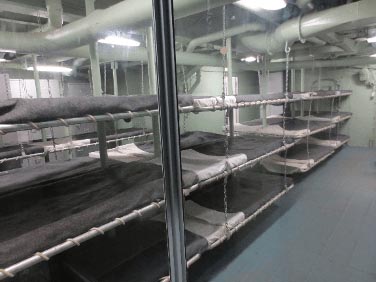
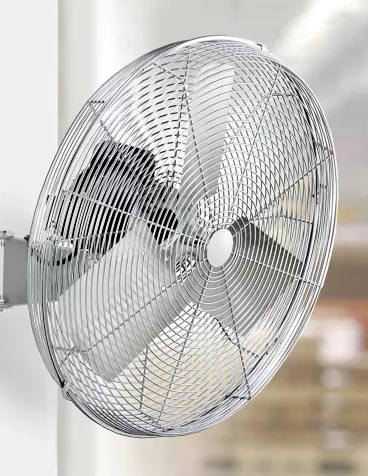
Having a bunk was great, compared to sleeping on deck on a cot with one exception. Because there was no air conditioning (just ambient temperature air blowing in), the temperature in the compartment was @ 110 degrees F. We slept with just underwear on. As electricians though we had the capability to install fans like the one shown, on our bunks. Each bunk was equipped with a light, so we just tapped into the light circuit to power the fans. It wasn’t perfect but at least we had air blowing right on us. We still all got heat rash because of the extreme temperatures. When we went to Sick Bay, they just gave us rubbing alcohol to put on the rash. These were the conditions as long as we were in the Far East. Back in the states it was usually cooler, especially in Fall & Winter.
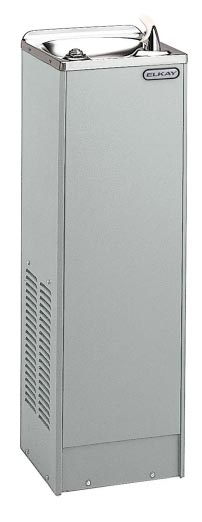
Life was rarely dull aboard the Oriskany. Everytime we left Hawaii & headed for Vietnam we would have a Russian bomber (Brown Bear) fly over us. Whenever they saw it approach us, general quarters (battle stations) was sounded We knew they were probably just checking us out, seeing which carrier we were & of course taking pictures of us, but you could never be too careful with the Russians. This was one of the times we got to savor the WWII C-Rations. I don’t remember all the different meals they had but I liked the spaghetti. They also included 4 cigarettes & matches. And people wonder why military men smoked. At that time it was a way to relax & take your mind of the war for awhile. I didn’t smoke that much but I did. After the Brown Bear left we went back to our routine of running the ship. As an electrician, I had many jobs plus every 8 hours we had to stand what we called a watch. The main watch we had was to monitor one of the 4 ship’s generators in one of the 4 engine rooms. We kept an eye on meters on switchboards & made minor adjustments to maintain 450 volts AC at 60 Hertz. It was very hot & noisy in the engine rooms. They provided us with ear plugs for the noise, ventilation ducts with air blowing on us & water coolers so we could stay hydrated. They also had salt tablet dispensers & recommended that we take at least one every 4 hours while working in the engine rooms. Years later they did away with the salt tablets because people were taking more than one tablet & getting sick as a result.
Everyone on the ship had specific jobs to do. If you enjoyed your particular job that was great, but unfortunately a lot of the crewmembers weren’t crazy about it, like the deck hands who had to maintain the exterior of the ship. They had to swab the deck, chip rust & old paint & then paint where they chipped. That was one of the least desirable tasks aboard. Another one was Boilerman. They had to work in the engine rooms in extreme heat, crawl in the bilges & clean dirt & oil from there. All these less desirable jobs gave the lower rank sailors the incentive to advance to the next rank. Once you became a Petty Officer you were able to delegate work to others & do more technical tasks. For everyone, once your work was done most of the sailors enjoyed playing cards, reading books, writing letters to loved ones back home, etc. During the day a lot of us would find a spot outside to lay in the sun for a half hour or so, during our 1 hour lunch break. It was usually in the 80s every day.
In my opinion we, the electricians, had one of the best jobs on the ship. Our job was to maintain all of the electrical equipment on the ship, which took us everywhere. When we didn’t have anything specific to do we could walk around, with our tool belt strapped to our side & look like we were on a mission. Nobody knew we were just on a sight seeing tour. The only places we couldn’t go were the areas where you had to have a security clearance to enter the spaces. Other than that nothing was off limits, even Officer’s Country. A lot of times I would pretend I was checking out the drinking fountains (Scuttlebuts), which led to my one of many nicknames, “Scuttlebut”. Other nicknames were Charlie (for Charlie Weaver), Beaver, Oglethorpe (I have no idea where this came from) & Wally. For the most part we got along really well.
Our sole purpose in Vietnam was to support the ground troops by doing bombing raids on enemy targets that we were given. In order to provide this support we had to have an Ammunition ship come alongside & transfer ammunition by way of what is called “Underway Replenishment”. Lines were sent from one ship to another by way of a gun. These lines were small & then were attached to larger lines & eventually steel cables. Bombs (250, 500 & 1000 lb.), bomb fuses, bullets & magnesium flares were placed in cargo nets, attached to pulleys that were attached to the steel cables, with guide lines, were pulled to our ship from the other ship until they could be lowered to our deck. Now everything is palletized but then everything was loose in the cargo nets. The bombs were rolled into the Hangar Deck where sailors would lift the bombs & place them on what was called a bomb skid (basically a cart on wheels) & then other sailors would roll these to an elevator & down to an ammunition locker where they were strapped into storage racks so they couldn’t move. Every time you handled a bomb you were lifting 125 lbs. It took 2 people for a 250 lb. bomb & 4 people for a 500 lb. bomb. 1000 lb. bombs weren’t lifted by hand but with a cradle & hydraulic or electric winch.
The bomb fuses were in metal ammo boxes & weighed about 50 lbs. One time when I was stacking a box of bomb fuses, it rolled off the stack & landed right on my big toe. I didn’t have steel toed shoes so it smashed my toenail. It took about 6 months for it to grow back in. The magnesium flares were cradled in your arms, one at a time, like you were carrying a baby & taken to the flare locker. Any time one of these flares were dropped, we were supposed to immediately take it to the side of the ship & throw it in the water.
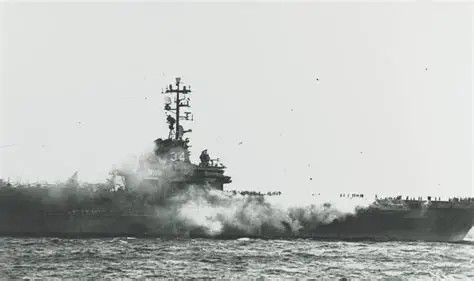
On October 26th, 1966, tragedy struck the ship when a crewmember, who was part of an ammunition handling party, dropped a Magnesium flare & instead of taking it up to the main deck & throwing it overboard, threw it into the flare locker. It ignited & then ignited other flares already in the locker. The fire that followed burned so hot it melted the plane elevator & welded it to the flight deck. 44 pilots & crew died from that fire from smoke inhalation. The ship had to return to the states to undergo extensive repairs in Hunter’s Bay Naval Shipyard in San Francisco, California. Due to a freak accident in the Electric shop, where I suffered a broken leg, I was flown off the ship earlier & sent to the Oakland Naval Hospital. I was part of a damage control team that fought the fire. I would have been right in the thick of things, fighting the blaze. I will never know what would have happened to me that day if I hadn’t broken my leg. God works in mysterious ways.
After my leg healed at the Oakland Naval Hospital I got orders to a Naval Security Group Activity (NSGA) base on the island of Okinawa. It was actually an Army base where I was stationed at Hanza Okinawa. All communications to & from the US & Vietnam went through this base. I was part of a support group for the base, as one of 2 Electricians. There were also several Engineman. Our main job on the base was to keep the lights on at the main communications building. There were 3 emergency diesel generators & 2 what they called, No break Power units or Uninterrupted Power Supply, which consisted of a diesel engine, clutch, generator, flywheel & motor. One of the 2 was running all the time as a motor generator (the motor turned the generator & flywheel). If there was any fluctuation of power, the motor would shut off, the clutch would engage & the diesel would immediately start & turn the generator, flywheel & motor. The communications building would see no power interruption whatsoever. In case of an Island power outage, which always occurred during Typhoons, our V12 emergency diesel generators would start & take over the electrical load. I was a very important job.